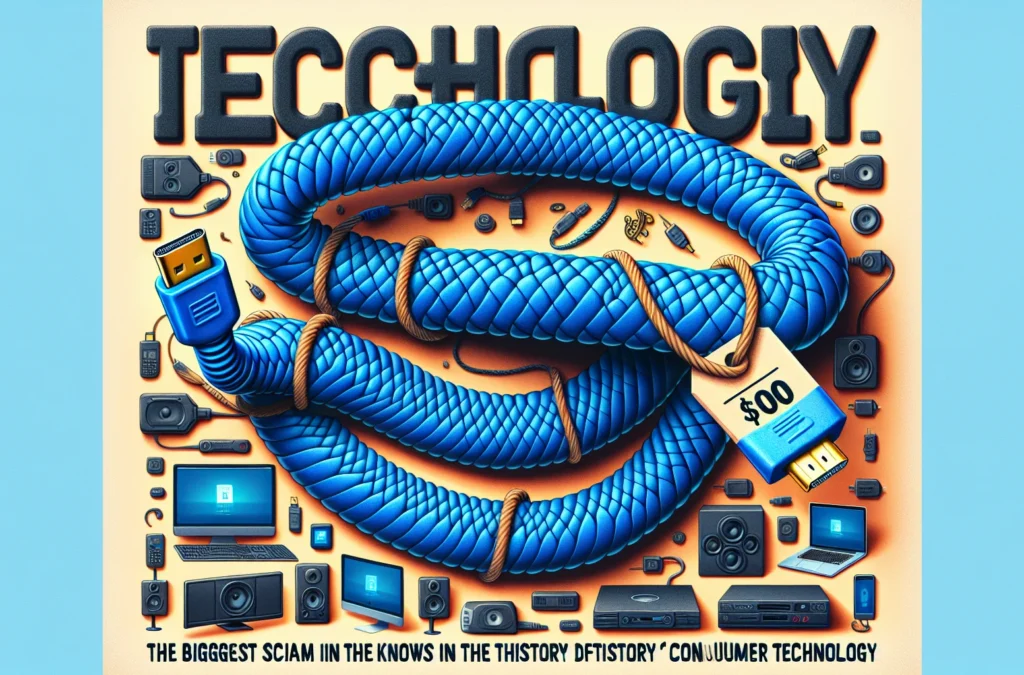
—sounds dramatic, but the facts back it up. For years, retailers and marketers have capitalized on consumer fear, selling overpriced HDMI cables with promises of crisper images and faster data transfer. In reality, a $10 cable performs identically to its $100 counterpart. Digital signals don’t degrade gradually like analog—they either work or they don’t. Once the connection is stable, there’s no visible or measurable benefit. This misleading markup preys on tech anxiety, turning a simple accessory into a profit goldmine. It’s time to expose the truth behind this widespread deception.
The Truth Behind Premium HDMI Cables: Why You’re Paying Too Much
In the world of consumer electronics, few products have generated more controversy and misinformation than HDMI cables. For years, retailers and manufacturers have pushed the narrative that expensive HDMI cables—some costing over $100—offer superior picture and sound quality. This claim lies at the core of what many now recognize as Technology,$100 HDMI Cables: The Biggest Scam in the History of Consumer Technology. The reality, backed by extensive technical evidence, is that these premium cables provide no measurable benefit over their low-cost counterparts—so long as both meet the same HDMI standards. Digital signals transmitted via HDMI are either received correctly or not at all. Unlike analog signals, where degradation can appear gradually, digital transmission follows an all-or-nothing principle. If a $10 HDMI cable meets the required specifications (such as HDMI 2.0 or 2.1), it will deliver the exact same 4K HDR, Dolby Atmos, and high-refresh-rate performance as a $100 version. The inflated price of premium cables often reflects marketing, branding, and perceived exclusivity—not actual performance. Consumers have increasingly wised up to this disparity, but many still fall prey to in-store upselling tactics at electronics retailers. Sales representatives may claim that thicker shielding, gold plating, or “better materials” justify the higher cost. While these features exist, they rarely improve real-world performance for typical home theater setups. Instead, what they do is increase profit margins for retailers and cable brands eager to capitalize on consumer ignorance. Understanding the technical specifications, consumer behavior, and marketing tactics involved is key to combating the widespread misconception that expensive HDMI cables are necessary. The following sections break down exactly why Technology,$100 HDMI Cables: The Biggest Scam in the History of Consumer Technology has persisted—and why it should finally be debunked.
How HDMI Technology Actually Works: A Digital Signal, Not Analog
HDMI (High-Definition Multimedia Interface) transmits data digitally, meaning information is sent in binary form—ones and zeros. This digital nature is fundamental to understanding why expensive cables offer no real advantage. In an analog system—like older RCA or coaxial cables—signal degradation can lead to fuzzy images or audio noise, and higher-quality materials can mitigate this. But with HDMI, as long as the signal reaches the destination without errors, the output is identical regardless of the cable. Modern HDMI cables are designed to meet specific standards such as HDMI 1.4, 2.0, or 2.1, each supporting different bandwidths, resolutions, and features like HDR or eARC. A certified cable at a given specification—whether it costs $8 or $100—ensures that the full bandwidth is supported. If both cables are certified and undamaged, the signal transmission is indistinguishable. There is no gradient of quality, only functionality. This makes the core promise of premium cables scientifically unfounded and illustrates why Technology,$100 HDMI Cables: The Biggest Scam in the History of Consumer Technology thrives on misunderstanding rather than engineering.
The Psychology Behind the Premium Cable Upsell: Fear and Prestige
The success of expensive HDMI cables is not based on technical superiority but on psychological manipulation. Retail sales strategies often rely on creating a sense of urgency or fear: “Your 4K TV deserves the best connection,” or “Don’t ruin your investment with a cheap cable.” These messages prey on consumers’ insecurities about getting the most out of their high-end electronics. Additionally, the use of terms like “audiophile-grade,” “oxygen-free copper,” or “triple shielding” sounds scientifically advanced, even when irrelevant to HDMI’s digital transmission. These terms evoke prestige and sophistication, appealing to buyers who equate price with quality. In truth, Technology,$100 HDMI Cables: The Biggest Scam in the History of Consumer Technology exploits this cognitive bias, leading people to overspend needlessly. Studies and blind tests by organizations like Consumer Reports and AVForums have repeatedly shown that participants cannot distinguish between video or audio quality delivered via budget versus premium HDMI cables. Yet, the myth persists, fueled by branding, fear of underperformance, and the instinct to trust retailers’ recommendations—even when those recommendations serve sales quotas.
Do Expensive HDMI Cables Last Longer? Debunking the Durability Myth
One of the most common defenses of high-priced HDMI cables is the claim that they are more durable due to superior materials. While it’s true that thicker jackets or reinforced connectors might theoretically offer better physical resilience, the reality is that most household installations don’t subject cables to extreme stress. Furthermore, wear and tear are more often due to installation practices (bending, pulling, pinching) than the cable’s build quality. A $10 HDMI cable properly handled will last just as long as a $100 one. Many budget cables now come with robust braided nylon sleeves or 24K gold-plated connectors—features once exclusive to premium brands. Longevity is also affected by standards obsolescence, not physical breakdown. Within a few years, newer HDMI versions may render older cables incompatible with future devices—regardless of price. In this context, paying a massive premium for slight build improvements makes little sense. The durability argument fails to justify the price gap, reinforcing the idea that Technology,$100 HDMI Cables: The Biggest Scam in the History of Consumer Technology capitalizes on perceived value rather than actual utility.
Real-World Testing: Blind Comparisons Confirm No Difference
Multiple independent and controlled tests have demonstrated that there is no discernible difference between budget and high-end HDMI cables when transmitting digital signals. In blind A/B tests, trained audiovisual professionals and everyday users alike are unable to identify which cable is in use based on picture quality, color depth, or sound fidelity. Organizations such as Wirecutter, CNet, and RTINGS.com have conducted comprehensive evaluations using calibrated equipment. Their measurements show identical data throughput, no difference in latency, and no variance in signal integrity between low-cost and premium cables—as long as both meet the same HDMI certification standards. For example, a $7 AmazonBasics HDMI 2.1 cable performs identically to a $120 AudioQuest model in carrying 48 Gbps signals required for 8K video. These findings confirm that marketing, not measurement, drives the price difference. This overwhelming evidence supports the broader condemnation of Technology,$100 HDMI Cables: The Biggest Scam in the History of Consumer Technology as a persistent myth with no foundation in engineering reality.
Cost Comparison Table: Features vs. Price of HDMI Cables
| Feature | Budget HDMI Cable ($7–$15) | Premium HDMI Cable ($80–$120) |
| Signal TypeTransmission Type> | Digital (identical to standard) | Digital (identical to standard) |
| Max Resolution Supported (e.g., 4K, 8K) | Up to 8K at 60Hz (HDMI 2.1) | Up to 8-consumingK at 60Hz (HDMI 2.1) |
| Bandwidth (up to 48 Gbps for HDMI 2.1) | 48 Gbps (if certified) | 48 Gbps (if certified) |
| Gold-Plated Connectors | Yes (common in budget models) | Yes (used as a selling point) |
| Cable Shielding | Basic to moderate shielding | Enhanced shielding (minimal real benefit) |
| Durability in Typical Use | 3–5 years with proper handling | 3–5 years with proper handling |
| Price Range | $7–$15 | $80–$120 |
| Value for Average Consumer | Extremely high — identical performance | Poor — no technical advantage |
Frequently Asked Questions
Are expensive HDMI cables significantly better than cheap ones?
In most real-world scenarios, HDMI cables over $10 offer no noticeable improvement in quality. HDMI is a digital signal standard, meaning it either works perfectly or fails completely — there’s no in-between. As long as a cable meets the required specifications and passes the signal without error, a $5 cable performs identically to a $100 one.
Why do some people insist that premium HDMI cables provide better picture and sound?
This belief often stems from marketing hype and misleading claims by retailers. Salespeople may promote expensive cables by suggesting enhanced color depth, smoother motion, or better audio, but these benefits only apply if the cable supports specific features (like HDMI 2.1), which many budget cables now do. Perception and placebo effects also play a significant role.
Can a cheap HDMI cable cause signal problems or dropouts?
While rare, poorly manufactured budget cables may have issues with shielding or connector durability, potentially leading to signal loss or intermittent disconnections. However, this isn’t exclusive to low-cost cables — even expensive ones can fail if poorly built. For most home setups under 6 feet, a well-reviewed inexpensive cable from a reputable brand performs flawlessly.
Is there any situation where a more expensive HDMI cable is worth it?
The only cases where a higher-priced cable might be justified are for longer runs (over 10 feet) or support of advanced features like 4K@120Hz, HDR, or eARC. Even then, moderately priced cables (under $25) from trusted brands often meet these needs without the inflated markup. For average users, premium branding adds cost, not performance.
About the Author