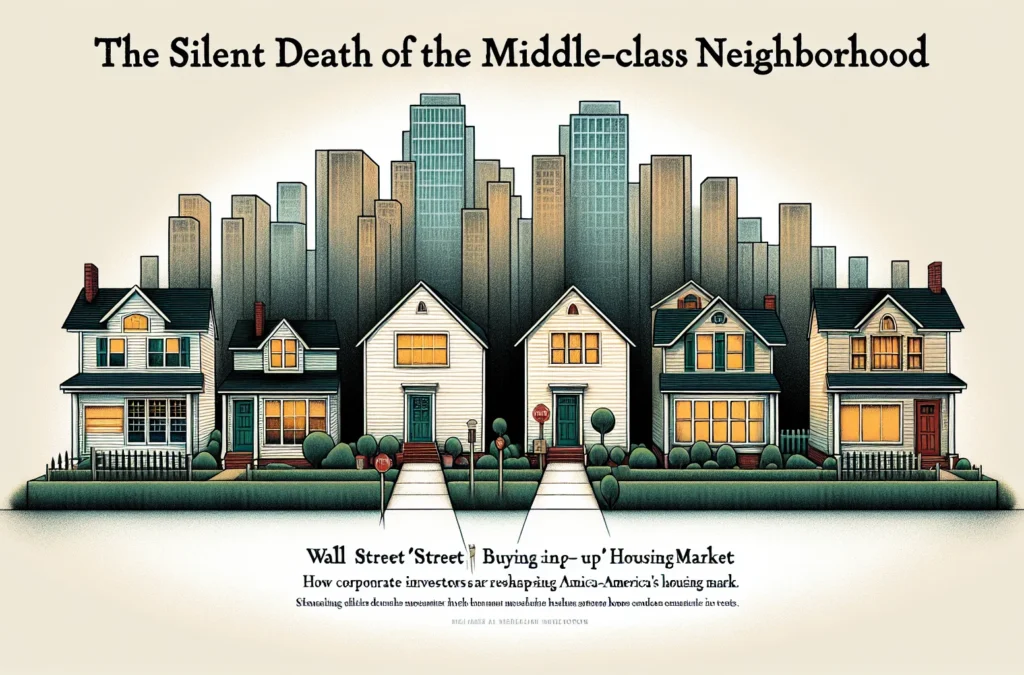
—once unthinkable, now undeniable. Across America, single-family homes are no longer just shelters; they’re portfolio assets. Institutional investors, fueled by cheap credit and algorithmic bidding, are outpacing local buyers, turning communities into corporate real estate holdings. The result? Skyrocketing rents, vanishing affordability, and the hollowing out of generational stability. What was built for families is now managed by spreadsheets. As neighborhoods transform into investment zones, the middle class is being priced out of its own future. This isn’t gentrification—this is financialization, and its quiet erosion is redefining the American Dream.
The Silent Death of the Middle-Class Neighborhood: Wall Street Buying Up Homes
The Silent Death of the Middle-Class Neighborhood: Wall Street Buying Up Homes is no longer a speculative concern—it’s a documented economic shift reshaping urban and suburban landscapes across the United States. Institutional investors, backed by vast financial resources and private equity funding, have aggressively entered the single-family home market, often outbidding individual buyers and local families. This transformation is altering neighborhood dynamics, escalating housing costs, and eroding homeownership as a pathway to generational wealth for average Americans. The long-term implications suggest a fundamental reconfiguration of community stability, affordability, and access to housing in post-pandemic America.
The Rise of Institutional Homebuying
Institutional investors such as Blackstone, Pretium Partners, and Amherst Group have emerged as dominant players in the U.S. residential real estate market since the 2008 financial crisis. After acquiring hundreds of thousands of foreclosed homes at discounted rates, these firms rebranded themselves as property management companies, leasing homes back to former owners and renters alike. Over the past decade, their expansion has accelerated, especially during the pandemic-era housing boom. With access to low-cost capital and bulk purchasing power, Wall Street firms can deploy automated bidding systems and close deals faster than traditional buyers. This systemic advantage allows them to acquire homes in middle-class neighborhoods at scale, often in low- to moderate-income areas, contributing directly to The Silent Death of the Middle-Class Neighborhood: Wall Street Buying Up Homes. This trend undermines organic community development and displaces long-term residents.
How Wall Street Affects Housing Affordability
When Wall Street firms purchase homes in bulk, they often convert them into rental properties managed by large-scale operators. While rental housing is essential, the financial model behind these portfolios prioritizes return on investment over tenant stability or affordability. Rents are frequently raised above market rates due to economies of scale and algorithm-based pricing models that maximize yield. As these firms acquire 5 to 15% of homes in targeted neighborhoods—sometimes more—the supply of homes available for owner-occupants shrinks. This scarcity inflates sale prices and creates bidding wars, pricing out middle-income families. The consolidation of housing stock by a few corporate landlords transforms neighborhoods into investor portfolios, where human needs take a backseat to profit margins—a clear symptom of The Silent Death of the Middle-Class Neighborhood: Wall Street Buying Up Homes.
Displacement and the Erosion of Community Fabric
Middle-class neighborhoods have traditionally offered social stability, civic engagement, and intergenerational mobility. However, The Silent Death of the Middle-Class Neighborhood: Wall Street Buying Up Homes is disrupting this foundation. When homes are owned by absentee corporations rather than families, community cohesion deteriorates. Institutional landlords are less likely to participate in school boards, neighborhood associations, or local events. Tenants, aware their leases can be terminated at any time, are less inclined to invest in their surroundings. Studies show increased corporate ownership correlates with decreased voter turnout, lower volunteerism, and higher residential turnover. This erosion of social infrastructure weakens neighborhood identity and undermines long-term community resilience, effectively replacing stable communities with transient, profit-driven tenancies.
Barriers to Homeownership for First-Time Buyers
First-time homebuyers—typically younger families, minorities, and lower-middle-income individuals—are among the most affected by corporate acquisition trends. Wall Street investors often bypass traditional financing constraints, using cash to outbid qualified individuals who rely on mortgage pre-approvals. According to a 2023 study by the Groundwork Collaborative, in the 50 largest U.S. metropolitan areas, institutional buyers acquired nearly 20% of all homes sold during peak buying seasons, with concentrations as high as 35% in cities like Atlanta and Phoenix. These purchases are disproportionately located in historically redlined or undervalued areas where affordability once made homeownership accessible. As corporations convert these homes into high-margin rentals, middle-class families lose the opportunity to build equity, reinforcing wealth gaps and deepening systemic inequality. This dynamic is a critical driver of The Silent Death of the Middle-Class Neighborhood: Wall Street Buying Up Homes.
Policy Gaps and Regulatory Challenges
Despite growing public concern, federal and state governments have been slow to regulate institutional ownership of single-family homes. No federal law currently limits how many homes a single entity can own, nor are there requirements for reporting ownership concentration at the neighborhood level. Local governments often lack the data or authority to challenge corporate acquisitions. While some municipalities, like Seattle and Minneapolis, have experimented with tenant protections or right-of-first-refusal programs for community land trusts, these are piecemeal solutions. Meanwhile, tax policies such as 1031 exchanges and favorable depreciation rules incentivize large-scale real estate investment, further tilting the playing field toward Wall Street. Without comprehensive regulatory reforms, including disclosure mandates and anti-concentration measures, the trend toward financialized housing will continue, ensuring that The Silent Death of the Middle-Class Neighborhood: Wall Street Buying Up Homes remains unchecked.
| Indicator | Data/Statistic | Source/Year |
| Share of homes bought by institutions (2022) | 18% of single-family home sales | CoreLogic / 2023 |
| Top institutional investor | Invitation Homes (Blackstone spin-off) | Wall Street Journal / 2023 |
| Average rent premium in corporate-owned homes | 12–18% above market rate | Joint Center for Housing Studies / 2022 |
| Estimated homes owned by top 25 firms | Over 400,000 homes | Groundwork Collaborative / 2023 |
| Neighborhoods with 20%+ institutional ownership | Over 120 U.S. ZIP codes | Urban Institute / 2023 |
Frequently Asked Questions
Who is buying up homes in middle-class neighborhoods?
Institutional investors and Wall Street firms are increasingly purchasing single-family homes in middle-class neighborhoods, often through subsidiaries or real estate investment trusts (REITs). These entities leverage bulk cash buys to outcompete individual buyers, reshaping the housing market by turning homes into income-generating assets rather than long-term family residences.
Why are investors targeting middle-class housing markets?
Middle-class neighborhoods offer a stable return on investment due to consistent rental demand and historically strong property appreciation. Investors see these areas as undervalued and scalable, especially after economic disruptions like the 2008 crash or post-pandemic market shifts. By acquiring homes in bulk, they achieve economies of scale in property management and financing.
How does this trend affect local communities?
As corporate ownership of homes rises, communities experience reduced homeowner stability, increased rental prices, and fewer opportunities for families to build wealth through homeownership. Local control diminishes as decision-making shifts from residents to distant asset managers focused on quarterly returns rather than neighborhood well-being.
Can anything be done to stop the corporate takeover of housing?
Some cities are implementing regulatory measures such as purchase restrictions, higher transfer taxes on institutional buyers, or giving residents right of first refusal. Advocates also push for federal intervention to limit investment loopholes and increase funding for community land trusts and affordable housing programs to rebalance power.
About the Author